Key Challenges
1. Sub-Microsecond Synchronization
Precise timing is essential when combining heterogeneous sensing modalities. PhysioEdge implements a separate 868 MHz radio channel for synchronization capable of achieving sub-microsecond clock alignment across distributed wireless nodes.
This level of determinism enables accurate multimodal fusion (e.g., combining ECG with motion data or correlating vibrations across nodes), and it is achieved without relying on expensive instrumentation, further underlining the value of thoughtful system co-design.
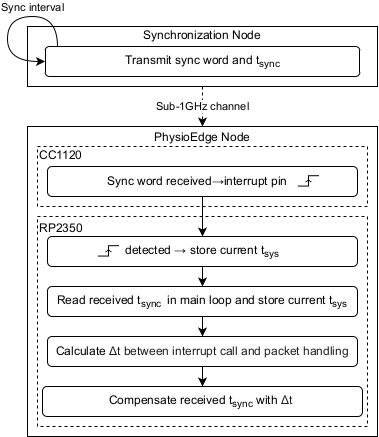
The flow chart below illustrates the synchronization mechanism. A central synchronization node periodically transmits a packet containing its current timestamp. The transmission interval is adjustable. This packet is sent over a dedicated 868 MHz radio channel used exclusively for synchronization, ensuring that data communication does not affect timing accuracy or precision.
When the packet reaches the CC1120 868 MHz radio module on the PhysioEdge node, the module triggers an interrupt. The timestamp of this interrupt is immediately captured so it can later be used to compensate for packet-handling latency. At an appropriate moment, the main core of the PhysioEdge node reads the received packet and extracts the central node’s timestamp. After applying the latency compensation, the node updates its system time using this corrected reference.
2. Compressive Sensing for Ultra-Low-Power Data Transfer
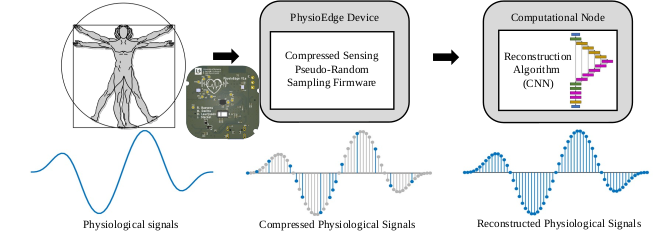
Large volumes of high-resolution sensor data quickly overwhelm wireless links and drain power budgets. Without the implementation of compressive sensing on the PhysioEdge, the datarate exceeds the theoretical limitation of BLE and only WiFi can be used. PhysioEdge integrates on-node compressive sensing, reducing data dimensionality before transmission while maintaining signal fidelity for reconstruction or downstream analysis.
As presented in the table below, this approach dramatically lowers energy consumption and enables long-duration, battery-powered acquisition. Key for wearable or distributed industrial deployments.
| Method | Compression Ratio | Datarate ↓ | Average Power ↓ |
|---|---|---|---|
| Wi-Fi | / | 1 Mbps | 25.0 mW |
| Wi-Fi | 10 | 100 kbps | 23.5 mW |
| Wi-Fi | 30 | 33 kbps | 22.8 mW |
| Bluetooth | 10 | 100 kbps | 6.6 mW |
| Bluetooth | 30 | 33 kbps | 4.9 mW |
3. High Sensing Density in a Compact Form Factor
Despite its small footprint, the system integrates a broad range of sensing modalities: IMU, ECG/EMG, analog inputs, environmental sensors, all on a high-density custom PCB built around accessible COTS components.
The result is a compact, lightweight module offering functionality typically associated with much larger or costlier systems. This highlights the strength of hardware–software co-design, careful PCB layout, and power-aware integration.